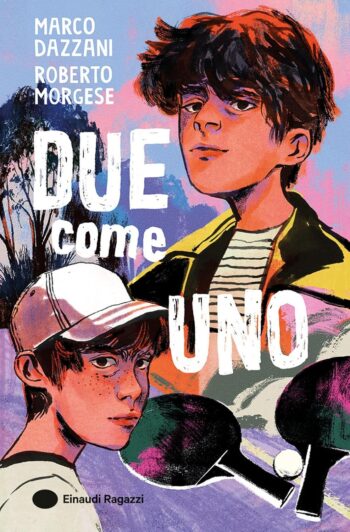
A novel about the courage to face diversity and transform it into strength. About sports as a space to get to know oneself, grow, overcome disabilities, and bridge the gaps between peers. A story that moves from pain to hope, from loss to rebirth.
Fifteen-year-old Juri is a table tennis prodigy, destined for greatness. Then, after a violent car accident, his father Dario dies and Juri loses his right arm. His life collapses: he withdraws from everyone, abandons sport, and watches his mother Beatricesink into depression. The only structure left in his days is hospital therapy, where the blunt psychologist Myriam pushes him to confront unresolved grief and a painful family secret linked to a miscarriage that further strains his bond with his mother.
Juri is unsettled by unexpected figures: Stampino, a hospital clown who is played by Giulio, the new coach at his old sports center, and above all Christian, a boy his age born with a hypotrophic arm. Christian reflects everything Juri refuses to accept about himself. Gentle, cautious, and overprotected, Christian avoids challenges, convinced he will fail. Despite Juri’s resistance, the two grow close. Christian defends him from bullying, follows him back to the table tennis hall, and invites him to train together. A deep friendship forms. Juri slowly rediscovers his competitive drive, while Christian beginsto claim small freedoms and confidence of his own.
Encouraged by Christian, Juri returns to training. Giulio agrees to let him compete only in doubles —and only with Christian. As the provincial championships approach, tension rises, especially with Alika, Juri’s former partner, who fears losing her place. At the tournament, Juri and Christian surprise everyone. Moving as one, they defeat several able -bodied pairs and reach the final, where they lose to Alika and Eva after a beautiful, fair match. Though defeated, they are celebrated as moral winners, admired for their unity and determination. Alika, too, realizes that true victory is not medals, but self-acceptance. The novel closes with a letter Juri wrote to his late father during therapy: a final step toward healing, reconciliation, and a future shaped not by loss, but by connection.