
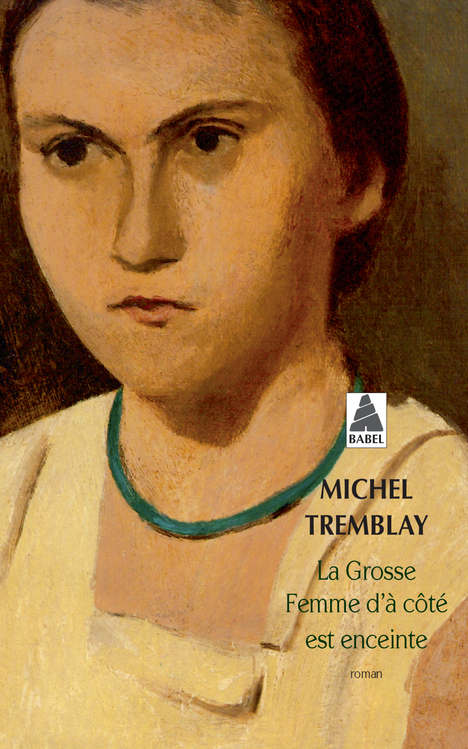
"I'd already read it in my twenties, but I rediscovered The Fat Woman Next Door Is Pregnant this winter. It was like reading it for the first time. An essential work, as much social as political, and above all, still relevant today.
Certainly, we no longer live four families in a five-and-a-half-room apartment on Fabre Street. The Plateau-Mont-Royal has gentrified. This reminds us how much the struggles of yesterday inform those of today." —Emmanuelle Lataverse, QUB (June, 2025)
The Fat Woman Next Door Is Pregnant takes place over a single day, May 2, 1942, in Montreal's working-class Plateau-Mont-Royal neighbourhood. A family gathers around a pregnant woman, the wife of Gabriel, son of Victoire and brother of Albertine (mother of Marcel and Thérèse) and Édouard, an obese shoe salesman. Several neighbours surround them: the prostitutes Mercedes and Béatrice, and a shopkeeper whose cat is named Duplessis. Three mysterious female figures knit and seem to watch over the family's destiny, reminiscent of the three Fates and adding a touch of the fantastical to the novel. A portrait of Montreal's working-class society, this novel inaugurates a series that has become a classic of Quebec literature and reveals Michel Tremblay as a great novelist celebrated worldwide. —Radio Canada
This exuberant novel offers a lively portrait of a working-class neighbourhood in Montreal in the early 1940s. Though author Michel Tremblay doesn't shy away from depicting the harsh realities of life, he also shows the inhabitants' joie de vivre. There's a large cast of colourful characters, including, in a touch of the mythic, the three Fates, in the guise of knitters Rose, Violette and Mauve. CBC Books
A Quebecois tragicomedy classic
A “Divine Comedy” of the extraordinary triumphs and tragedies of ordinary people caught up by circumstances (or just life) that go from the ridiculous to the sublime.
It is the glorious second day of May, 1942. The sun is drawing the damp from earth still heavy with the end of a long Quebec winter, the budding branches of the trees along rue Fabre and in Parc Lafontaine of the Plateau Mont Royal ache to release their leaves into the warm, clear air heralding the approach of summer.
Seven women in this raucous Francophone working-class Montreal neighbourhood are pregnant—only one of them, “the fat woman,” is bearing a child of true love and affection. Next door to the home that is by times refuge, asylum, circus-arena, confessional and battleground to her extended family, with ancient roots in both rural Quebec and the primordial land of the Saskatchewan Cree, stands an immaculately kept but seemingly empty house where the fates, Rose, Mauve, Violet and their mother Florence, only ever fleetingly and uncertainly glimpsed by those in a state of emotional extremis, are knitting the booties of what will become the children of a whole new nation.
“The fat woman” both is and is not Michel Tremblay’s mother—her extended family and neighbours more than a symbol of a colonized people: abandoned and mocked by France; conquered and exploited by England; abused and terrorized by the Church; and forced into a war by Canada supporting the very powers that have crushed their spirit and twisted their souls since time immemorial. This is a “divine comedy” of the extraordinary triumphs and tragedies of ordinary people caught up by circumstances that span the range of the ridiculous to the sublime.